LG INNOVATE 2026 · MELBOURNE
A talk for Australian local government leaders at the National AI Summit for Local Government.
2–3 September 2026 · Melbourne Town Hall · LG Innovate 2026 →
Want to know more, or want a deeper conversation… Schedule a Call · hello@ai-explorer.com.au
Two organisations buy the same agents this year. Eighteen months later, one is thriving and the other is quietly falling apart.
The gap is not the technology. It is the human–AI interface: how people and agents actually work side by side. Almost nobody is designing it on purpose. You still can. Cultures set quickly and reverse slowly.
You can feel it when you walk in. People are busy but wary. Agents were switched on inside existing processes as an efficiency mandate. Colleagues quietly double-check outputs they do not trust. Some run AI off the record. Nobody says out loud what half the floor is thinking. A low hum of threat: if the agent gets it wrong, someone will be blamed, and it will not be the agent. Same tools. An adrenaline organisation: fear, urgency, blame, reactive control.
Same technology, a different feeling. People compare notes openly: “my agent nailed the first draft but missed the client’s risk appetite, so I reshaped it.” An agent produces the rough version; a person sets the intent, makes the judgement call, and owns the outcome. Safe enough to say “that output is wrong” and try again. An endorphin organisation: discovery, purpose, reflection, mutual trust.
Both Mondays are available right now, from the same tools. Which Monday a council ends up living is not luck and not a technology decision. It is a design choice leaders are making today, most without realising they are making it at all.
The usual playbook steers you toward Monday A: bolt agents onto today’s processes and yesterday’s work simply runs faster. The place people and agents actually meet is decision rights, accountability, trust and status. None of that lives in the software. You cannot buy the interface from a vendor. You have to design it.
In one breath: every time a human and an agent work together, a contract exists: someone has the final say, some stance governs the relationship, and someone owns the outcome when things go wrong. The only choice is whether that contract is written deliberately or by drift. Drift, under pressure, writes the anxious version.
3 decisions. 7 conditions. 1 energy state.
Get these three right for each type of work and co-work functions. Leave them implicit and the organisation drifts to Monday A. Treat the three as a gate: if any cannot be answered for a given human–agent pairing, that pairing is not ready to deploy.
01
Is the human in the loop (approves each step), on the loop (monitors and can override), or off the loop (sets parameters and reviews outcomes)? Choose by stakes. A signature is not control unless the named person has time, information, authority and a usable override.
02
Tool, assistant, colleague, oracle, or autonomous agent. The organisation sets a house default. Each job inherits it unless the work genuinely needs a different one: and the product can actually hold that stance. A colleague is challenged and improved. An oracle is deferred to. Leave stance implicit and behaviour becomes inconsistent.
03
Name the practised route for challenging output or reporting agent failure. Name the human accountable for the outcome and its correction. A role, a committee, or “the system” cannot own it.
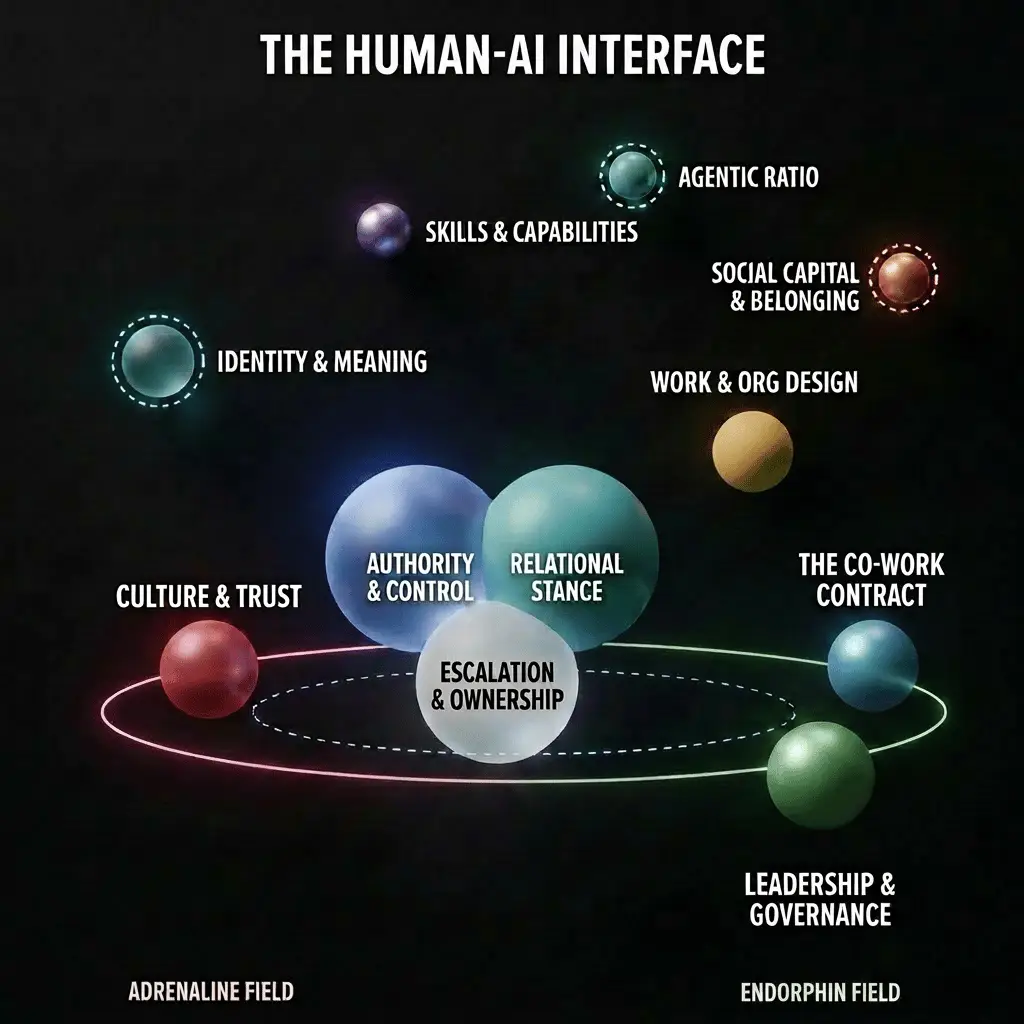
The contract cannot hold in a vacuum. Around it sit seven organisational conditions:
Leadership & Governance
Culture & Trust
Work & Organisational Design
Skills & Capabilities
Identity & Meaning
Social Capital & Belonging
Agentic Ratio
Leaders set conditions and govern visibly (they do not do every task). Trust decides whether people escalate or conceal. Work is designed backwards from the outcome, not bolted onto yesterday’s process. Skills include evaluating output, not only prompting. Identity answers “what am I at work for now?” Belonging is the human-to-human fabric no agent replaces. The agentic ratio is a redesign trigger each time the share of agent work rises: not a target to maximise.
Everything sits inside one medium: Monday A (adrenaline: fear and blame) or Monday B (endorphin: curiosity and trust). Same twelve pieces, wrong atmosphere, wrong organisation. Design the energy on purpose: psychological safety, visible leadership modelling, honest naming of the anxiety.
FICTION
Fiction. Characters and place are invented for the talk.
At LG Innovate, the talk follows Wenlow, a fictional Victorian city under pressure, and WENDY (WENlow’s Digital work-all-Y): the AI agent brought in to help planning keep up.
WENDY is not the villain. The technology worked. What was not designed was the human-AI interface: who had the final say, how people were meant to relate to WENDY, and who owned the outcome when something felt wrong. Reasonable choices stacked into a weak system. Planners signed more than they could check. A worry became an IT ticket. A signature stood in for control. Savings funded more checks instead of judgement, learning and belonging. It came at a cost to trust, staff, and the public.
The model names what those choices were really deciding: Authority & Control, Escalation & Ownership, Leadership & Governance, and the conditions that must shift as agent use grows.
Test one high-stakes pairing:
If any answer is missing, the pairing is not ready (not “we’ll settle it in the pilot.”).
Download the Human–AI Interface one-pager and the companion diagnostic: walk one high-stakes pairing through the gate and leave with one owned next move.
Want to know more, or want a deeper conversation… Schedule a Call · hello@ai-explorer.com.au · ai-explorer.com.au
Use Download the one-pager & diagnostic above to send your enquiry. We will send the one-pager once it is ready.
Where: LG Innovate 2026 · National AI Summit for Local Government
When: 2–3 September 2026
Venue: Melbourne Town Hall
Event: davidsonwp.com/lg-innovate-2026
Built for council leaders who are deploying (or about to deploy) agentic AI and want the human interface designed on purpose: decision rights, relational stance, ownership, and the conditions that hold them.
Presented through AIx (AI Explorer), practical AI learning for Australian workplaces. This page shares the Human–AI Interface model and the conference talk. It is not a workshop enrolment page and not legal or compliance advice.
Views presented are those of AI Explorer. No employer endorsement is implied.
This site does not promise a particular productivity, return-on-investment, compliance, or organisational outcome. AIx does not provide legal, privacy, financial, procurement or compliance advice.
Pick a time below for a 30-minute Exploration Meeting.